Ask three people what the exchange rate is on a given day and you can get three different answers, and all three can be correct. There is the mid-market rate you see quoted on the news, the rate your bank gives you, and the rate the currency counter at the airport offers. The gap between those numbers is where a chunk of your travel money quietly disappears if you are not paying attention. This piece walks through what each rate actually means and how to check, before you travel, roughly what your money will be worth.
What "the exchange rate" actually means
When people say "the exchange rate" they usually mean the mid-market rate — the midpoint between what buyers and sellers are trading a currency pair at on the wholesale market at that moment. Banks, card networks and currency exchange counters use this as a reference point, then add their own margin on top. You, as a retail customer, almost never get the mid-market rate itself. You get the mid-market rate minus a spread, plus sometimes a flat fee as well.
You can check the current mid-market rate for any pair using a tool like our exchange rate calculator, which gives you a reference point before you compare it against what a bank or exchange counter is actually offering you.
A worked example: the hidden margin
Suppose the mid-market rate between US dollars and euros is, hypothetically, 1 USD = 0.92 EUR. You walk up to an airport currency exchange counter with 500 USD to convert for a trip to Italy. The board says 1 USD = 0.85 EUR. Here is the arithmetic:
- At the mid-market rate: 500 × 0.92 = 460 EUR.
- At the counter's rate: 500 × 0.85 = 425 EUR.
- Difference: 35 EUR, or about 7.6% of your money, gone to the margin.
That 7.6% is an entirely hypothetical example, but margins of a similar scale at airport counters are not unusual, which is exactly why it pays to check the mid-market figure first and treat it as your benchmark for judging any offer.
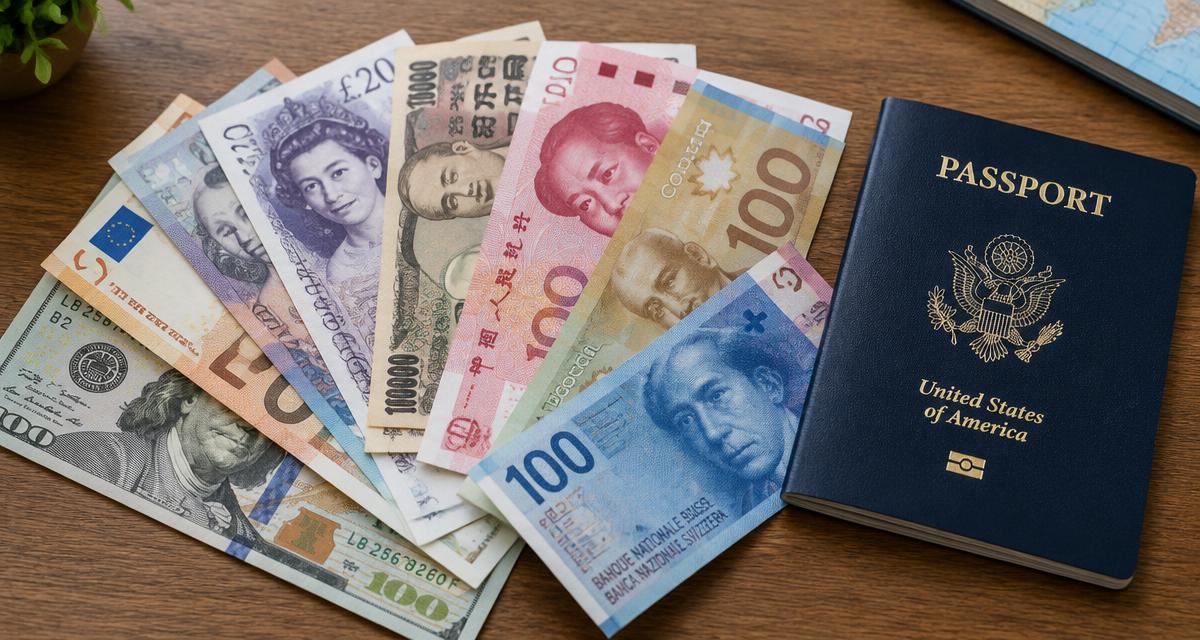
Why exchange rate margins are not the same everywhere
The margin a provider adds on top of the mid-market rate is not a fixed, regulated number — it is set by each bank, card network or exchange bureau based on their own costs and how much competition they face. A busy currency bureau on a city high street, competing with several others on the same block, often prices more aggressively than a single counter inside a departure lounge where travellers have no other option. The same logic applies online: a currency exchange app competing for your business nationally has more reason to quote close to the mid-market rate than a counter that only sees you once, right before your flight. This is why shopping around, even for ten minutes with a few browser tabs open, tends to pay off more than brand loyalty to a single bank.
How to read a rate board without getting confused
Exchange boards usually show two prices for each currency pair — a "we buy" rate and a "we sell" rate. If you are converting your home currency into a foreign one to take on your trip, you care about the "we sell" side, since that is the rate at which the provider sells foreign currency to you. If you come home with leftover foreign cash and want to convert it back, you look at the "we buy" side instead, which is usually less favourable. The gap between these two prices is the provider's spread, and a wider gap generally signals a worse deal for you as a customer, regardless of which direction you are converting.
Cards versus cash versus prepaid currency cards
Paying by card abroad routes your transaction through a card network that applies its own conversion, and your bank may add a foreign transaction fee on top of that. Some cards — often described as fee-free or travel cards — waive that extra fee and pass through a rate close to the network's own mid-market-linked rate. Prepaid travel currency cards let you lock in a rate in advance by loading a balance before you travel, which can be useful if you expect rates to move against you, but they usually carry their own margin at the point you load the card. Cash withdrawn from a foreign ATM typically uses the card network's rate too, plus a withdrawal fee from your own bank and sometimes one from the ATM operator.
Dynamic currency conversion: the trap at the terminal
When you pay by card overseas, a card terminal or online checkout will sometimes ask whether you want to pay "in US dollars" (or your home currency) instead of the local currency. This is dynamic currency conversion, and it almost always works against you. The merchant's payment processor picks the conversion rate, not your card network, and that rate usually includes a wide margin disguised as convenience. The rule of thumb is simple: always choose to pay in the local currency, and let your own card issuer handle the conversion.
Why rates move while you are away
Exchange rates are not fixed for the length of your trip. They shift with interest rate decisions, inflation data, political events and simple supply and demand in currency markets. A rate that looked attractive the week before you left can look less attractive by the time you land, and vice versa. If you are converting a large sum, watching the rate over several weeks rather than converting everything on a single day can smooth out some of that volatility, though nobody can reliably predict which direction a currency will move.
Planning a multi-currency trip
If your trip crosses several currency zones — say a flight into one country, a train into another and a short ferry hop to a third — it helps to convert your overall budget into each local currency before you go, so you are not doing mental arithmetic mid-trip. Our currency conversion calculator lets you run each leg of a trip through the current rate so you know roughly what your daily spending money is worth in each place, and our broader travel budget calculator can help you build that into a full trip plan.
Travelling to a country with a weaker or stronger currency
If your home currency is relatively strong against your destination's currency, prices can feel deceptively cheap, and it is easy to overspend simply because the numbers on menus and price tags look small. Doing a rough mental conversion before you order — rounding the local price to your own currency using the mid-market rate as a guide — helps keep spending honest. The reverse applies too: if your currency is weak against the destination's, budget a bit more buffer than you think you need, since small purchases can add up faster than expected once converted back.
A simple checklist before you convert any money
- Look up the current mid-market rate as your benchmark, not what a single provider quotes.
- Compare at least two or three providers — bank, card, prepaid card and/or exchange counter.
- Ask about flat fees as well as the margin built into the rate.
- Always decline dynamic currency conversion and pay in the local currency.
- Avoid converting large sums at airport counters, where margins tend to be widest.
- Keep a small amount of local cash on hand for places that do not take cards.
When it is worth converting before you leave
For most destinations where cards are widely accepted, you do not need a large pile of cash converted before departure — a card with low foreign fees plus a small cash float on arrival usually works out cheaper than converting hundreds of dollars at a home currency exchange. The exception is destinations where card acceptance is patchy, or where you are arriving late at night and want enough local cash for a taxi and a meal without hunting for an ATM. In those cases, converting a small, deliberately modest amount in advance is a reasonable insurance policy, not a full currency strategy.
Frequently asked questions
Is the exchange rate I see on Google the rate I'll actually get?
No. Search engines and financial news sites generally show the mid-market rate, which is a reference point rather than a retail offer. Banks, card issuers and currency exchange counters add their own margin, so the number you are quoted at the till or on your statement will usually be a little less favourable.
Does it matter which city or airport I exchange money in?
Generally yes. Exchange counters inside airport departure areas tend to have the widest margins because travellers have little choice once they are through security. High street exchange bureaus and online providers that deliver currency before you fly are often more competitive, so it is worth comparing before you reach the airport.
Should I use a credit card or a debit card abroad?
Both can work well if the issuer charges low or no foreign transaction fees, but check your own provider's terms before you travel — some cards charge noticeably more for cash withdrawals than for card purchases, and interest can apply quickly to a credit card cash advance.
How do I know if a rate is "good"?
Compare it to the current mid-market rate for that currency pair. The closer a provider's rate sits to the mid-market figure, and the lower any additional flat fee, the better the deal. Treat the mid-market rate as your benchmark rather than trusting a single provider's claim of a "low" or "no fee" rate at face value.
Exchange rates move constantly and the figures above are illustrative examples, not current quotes or advice. Always check live rates with your bank, card provider or a reputable source such as the European Central Bank's reference rates before you convert money for a trip. See our full list of travel calculators for more tools to plan your trip.