REAL ID vs Passport: What ID Do You Need for US Domestic Flights?

Updated September 26, 2026 Β· 5 min read Β· Checked against official sources Β· Editorial policy

Traveller showing an identity card at a US airport security checkpoint

A domestic boarding pass does not mean every driver's licence will work at security. Adults need identification accepted by TSA, and a valid US passport is one option. That makes the practical choice less about β€œREAL ID or passport?” and more about which accepted document you already have, can protect during the trip and will remember to bring.

What is REAL ID?

REAL ID is a US federal standard for state-issued driver's licences and identification cards. Compliant cards are usually marked with a star in the upper corner, although the exact design varies by state. To get one, you visit your state's licensing agency with documents proving your identity, Social Security number and address. A REAL ID is not a travel document: it does not let you enter another country.

IDs TSA commonly accepts

  • A REAL ID-compliant driver's licence or state ID card.
  • A US passport or US passport card.
  • DHS trusted traveller cards, such as Global Entry or NEXUS.
  • A US military ID or a permanent resident card.
  • Certain foreign government-issued passports and other listed documents.

TSA publishes the full, current list on its website, and it can change. Check it before you fly rather than relying on memory or a friend's experience.
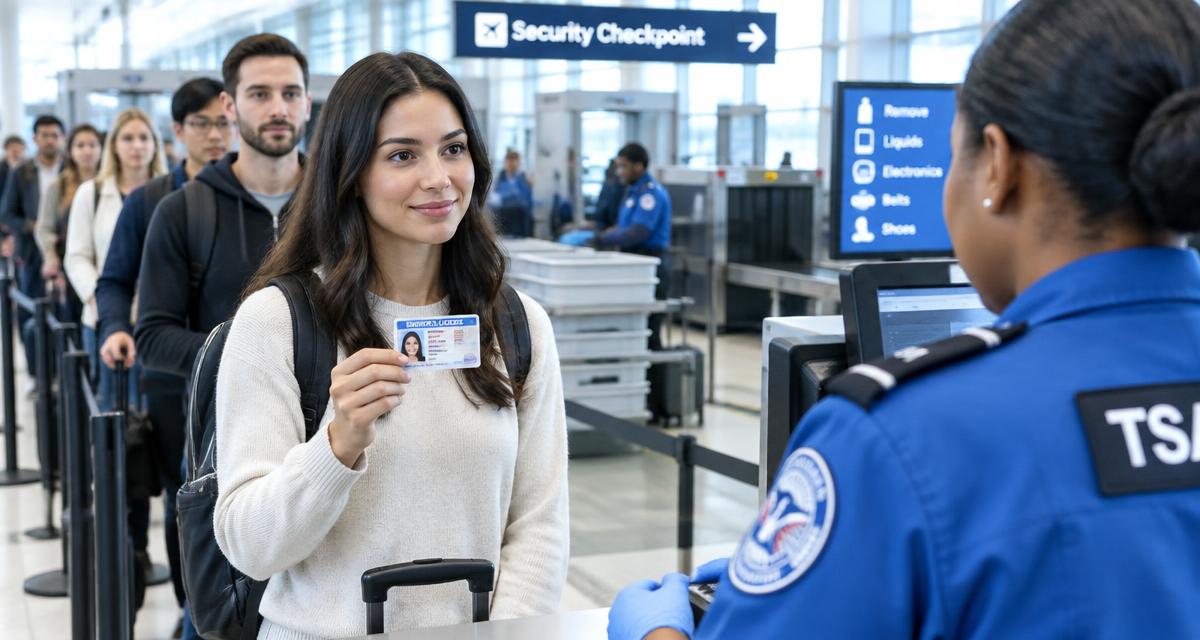
Traveller showing an identity card at a US airport security checkpoint
At security, adults need an accepted ID β€” REAL ID or an alternative such as a passport.

Passport or REAL ID: which should you use?

If you already have a valid passport and do not plan to upgrade your licence, you can use the passport for domestic flights. The downside is carrying a document that is expensive and slow to replace if lost. Many travellers prefer a REAL ID licence for everyday domestic travel and keep the passport for international trips. A passport card is a smaller option that TSA accepts domestically, but it cannot be used for international air travel.

If you are flying internationally, you need a passport regardless of your REAL ID status. Check that it has enough validity for your destination with our passport validity checker.

What if you arrive without an accepted ID?

TSA says travellers without acceptable identification may face additional identity checks and may be unable to pass the checkpoint if their identity cannot be confirmed. Procedures can change and take extra time. Do not treat this as a substitute for bringing an accepted document; check TSA's current instructions before leaving for the airport.

Children and domestic flights

TSA does not require children under 18 to show ID when travelling with an adult companion within the United States, though airlines may have their own rules, especially for unaccompanied minors or lap infants. For international trips, children need their own passports; our guide to travelling with children covers consent letters and other documents.

Choose the document before travel day

Open your wallet and inspect the actual card rather than relying on memory. If it is not REAL ID-compliant, place an accepted alternative with your travel items now. Travellers who use a passport domestically may also want a secure reminder to remove it from a jacket or day bag after the trip; replacing a lost passport is much harder than replacing a routine item left at security.

Cruises and land border crossings

REAL ID does not replace a passport for cruises or crossing into Canada or Mexico. Closed-loop cruises and land crossings have their own document rules, explained in our cruise passport guide and Mexico passport guide.

Official sources

TSA sets accepted-ID rules and may change its procedures. Check the current list on tsa.gov before travel, particularly if you plan to use a less common document.

What to do if your licence is not compliant yet

If your state licence does not show the REAL ID star marking and your travel date is close, the simplest fallback is a passport book or passport card. TSA also accepts certain other documents, such as trusted-traveller cards and permanent resident cards, but the list is specific and it changes, so read it on tsa.gov rather than relying on a summary like this one. The practical point is that you need one document from the accepted list β€” you do not need both a REAL ID licence and a passport for a domestic flight.

If you have already applied for a REAL ID and are waiting for the card to arrive, check with your state licensing agency whether the temporary paper document they issued is accepted for your purposes. Paper temporaries are generally not accepted at the checkpoint, which is exactly why travellers get caught out: the application is done, but the card is not in hand. Plan around the card you physically hold on the day of travel, not the one you have applied for.

A pre-flight document routine that avoids surprises

A week before any domestic flight, take the document you plan to use out of your wallet and check three things: the name matches your booking exactly, the document is not expired, and it is on TSA's current accepted list. If any of those three fails, you still have time to switch to a different document or fix the booking name. Leaving this check to the morning of the flight turns a solvable problem into a missed departure.

Finally, remember that REAL ID is about federal acceptance of state identification. It does not change what airlines require for check-in, and it has no role at all once your trip crosses a border. Treat it as one item on your document checklist, not as a travel document in its own right.

Children, names and other edge cases

TSA does not require children under 18 to show identification on domestic flights when travelling with an adult, though the airline may have its own rules, so check with the carrier. Name mismatches are the other common trap: if your booking says "Mike" and your document says "Michael", fix the booking with the airline well before departure rather than arguing about it at the checkpoint. Small mismatches are often tolerated, but you do not want your travel day to depend on an officer's discretion.

Check your own trip in 30 seconds

Enter your passport expiry date and destination to see your last safe entry date, visa status, documents checklist and readiness score.

Run the free checker

Keep reading

Do You Need a Passport to Go to the Bahamas?

Whether you need a passport for the Bahamas depends on how you travel, your citizenship and how long you stay. Here is what to carry by air, by sea and by cruise.

Do You Need a Passport to Go to Mexico?

Flying to Mexico, driving across the border, or arriving by ship? The document rules differ. Here is what US, Canadian and other travellers should carry.

Do You Need a Passport to Go on a Cruise?

Closed-loop cruises, one-way sailings and repositioning voyages have different document rules. Here is when a passport is required and when it is only strongly advised.

How to Get a Visa for Europe

Schengen short-stay visas, national long-stay visas and the new ETIAS travel authorisation explained, with the documents, timings and costs to plan for.

Passport Expiring Soon Before a Trip? What to Check First

A practical decision guide for a passport near expiry: check the destination's validity rule, connections, airline requirements and renewal options before you travel.

Travelling Internationally With Children: Document Checklist

What to prepare when a child crosses borders: passports, parental consent, name differences and where to check the rules for your actual itinerary.

Do You Need a Transit Visa for a Connecting Flight?

A connection can come with its own entry rules. Learn how to check airside transfers, self-transfers, baggage collection and transit visa requirements.

How Long Does It Take to Get a Passport? Planning Your Timeline

Passport processing times change through the year. Learn how to build a safe timeline, when to pay for faster service and what to do if your trip is close.

Lost Your Passport Abroad? What to Do, Step by Step

A calm, practical plan for a lost or stolen passport overseas: reporting it, contacting your embassy, emergency travel documents and rebooking your trip home.

Can You Travel With a Damaged Passport?

Water damage, torn pages, a loose cover or a damaged chip can get you refused boarding. Here is how to judge normal wear against damage that needs replacing.

The EU Entry/Exit System (EES) Explained for Travellers

The EES replaces passport stamps with digital records of fingerprints and a facial image at Schengen borders. Here is who it affects and how to prepare.

Travel Insurance Calculator: How Much Travel Insurance Do You Really Need?

A practical way to work out how much medical, cancellation and baggage cover your trip needs, and how to compare quotes fairly using a simple calculator.

JR Pass Calculator: Calculate Whether a Japan Rail Pass Is Worth It

How to add up your Japan train journeys, compare them with the current JR Pass price, and decide whether the pass or single tickets make more sense.

Travel Time Calculator: How to Calculate Your Total Travel Time

Door-to-door travel time is much more than the flight. Here is how to add up every stage of a journey, including time zones, layovers and the airport.

Flight Distance Calculator: Find the Distance Between Any Two Cities

How flight distance is measured, why great-circle routes look curved on maps, and what distance tells you about flight time, fares and points.

Travel Cost Calculator: How Much Will Your Trip Really Cost?

A step-by-step method for estimating the real cost of a trip, including the small, forgotten expenses that blow most travel budgets.

Qantas Points Calculator: How to Calculate the Value of Your Travel Points

How to work out what your Qantas Points are actually worth on a specific redemption, and how to tell a good use of points from a poor one.

Exchange Rate Calculator: Calculate Currency Conversion Before You Travel

How exchange rates, margins and card fees really work, and how to calculate what your money will be worth before you leave home.

Japan Travel Guide: How to Calculate Your Budget, Distance, Time and Transportation Costs

A planning guide for Japan that shows you how to calculate your daily budget, distances between cities, journey times and transport costs.

Travel Insurance: What Does It Cover and How Much Could You Save With the Right Policy?

What travel insurance usually covers, what it often excludes, and how the right policy can protect you from the costs that hurt most when a trip goes wrong.

Best Travel Packing Cubes: 15 Packing Cubes That Make Packing Easier

Compare 15 packing cube options by packing style, suitcase fit and practical trade-offs, with a carry-on packing example and a buying checklist.

Best Travel Wallets: 15 Travel Wallets to Keep Your Essentials Organized

Find a travel wallet that fits your documents and daily routine: 15 options, passport storage tips, security trade-offs and a pre-flight checklist.

Best Places to Travel With Kids: 25 Family-Friendly Destinations

Explore 25 family holiday ideas with age suitability, manageable day plans and honest planning trade-offs, from city breaks to nature trips.

Best Places to Travel Solo: 25 Amazing Destinations for Solo Travelers

Compare 25 solo travel destinations by transport, social opportunities and planning challenges, with a first-trip checklist and practical safety habits.

Travel Itinerary Template: How to Plan the Perfect Trip Step by Step

Copy a practical travel itinerary template and plan your route, transfers, daily priorities, budget and backup options without overfilling every day.

Japan Travel: The Ultimate Japan Travel Guide for First-Time Visitors

Plan your first Japan trip with a realistic Tokyo and Kyoto route, transport choices, accommodation checks, food guidance and practical arrival advice.

This article is general information, not legal or immigration advice. Entry and document rules change often β€” always confirm with the official government authority for your destination and with your airline or cruise line before you travel. Read our full disclaimer.