The Best Travel Bags for Every Type of Trip: Carry-On, Backpack, or Duffel?

Updated October 24, 2026 · 9 min read · Checked against official sources · Editorial policy

Carry-on suitcase, hiking backpack and canvas duffel bag side by side

A suitcase feels like an excellent choice until you reach the fourth flight of stairs. A backpack seems wonderfully practical until you spend an hour standing with it on. The best travel bag is not necessarily the toughest, lightest or most expensive: it is the one that makes your particular journey easier.

Start with the awkward parts of your trip, not the attractive features on a shop display. Think about station changes, uneven streets, luggage storage and how far you will actually carry everything. Here is how to choose between a carry-on suitcase, a travel backpack and a duffel without buying more bag than you need.

1. Start with the journey between your stops

Picture your longest transfer from door to door. Will you roll straight from a taxi into a hotel, or walk uphill from a bus stop? Will you have lifts, or narrow staircases? Count hotel changes too. Unpacking once gives you different priorities from moving every second morning.

Your comfort matters more than travel habits borrowed from someone else. If carrying weight aggravates your back or shoulders, a backpack is not automatically the practical option. Equally, wheels offer little help on sand. Choose for the surfaces and lifting you can reasonably manage, including getting a bag onto a train rack.

  • Mostly smooth pavements and one base: start with a suitcase.
  • Frequent stairs and mixed transport: consider a travel backpack.
  • Car travel and bulky, soft equipment: look at a duffel.

2. When a carry-on suitcase wins

A wheeled carry-on is a strong choice for city breaks, business trips and hotel stays with straightforward transfers. You avoid carrying the full load for most of the journey, and a structured interior makes clothes easier to arrange. If you pack a jacket or need to find a shirt before dinner, that predictable layout is useful.

Four spinner wheels move easily beside you on smooth floors, although small wheels can struggle with cobbles and broken paving. Two-wheel cases generally need tilting and pulling but can have larger, more sheltered wheels. Neither design removes the need to lift the case over steps. Try the handle at your natural walking height before buying.

Hard shells provide structure but can scuff, and opening a split case needs floor space. Soft-sided cases may offer accessible outer pockets and a little flexibility. Pick the opening style you will enjoy using in a small room, rather than assuming one shell type is always better.

3. When a travel backpack wins

Travel backpacks earn their place on rail trips, hostel routes and journeys involving stairs, rough paths or frequent transfers. Keeping both hands free helps when you need a handrail or a phone for directions. A suitcase-style opening also saves you digging through a top-loading bag for socks at the bottom.

Fit is more important than an impressive capacity. Look for adjustable shoulder straps, a suitable back length and, for heavier loads, a supportive hip belt that fits properly. A sternum strap can improve stability, but it does not make an overloaded bag comfortable. Try the bag with a realistic load, not just its paper stuffing.

A travel backpack is not necessarily a hiking pack. For multi-day walks, carrying comfort, ventilation and equipment attachment may take priority over a neat laptop compartment. For city-to-city backpacking, easy access and straps that tuck away for transport can be more useful. Be honest about how much walking your itinerary involves.
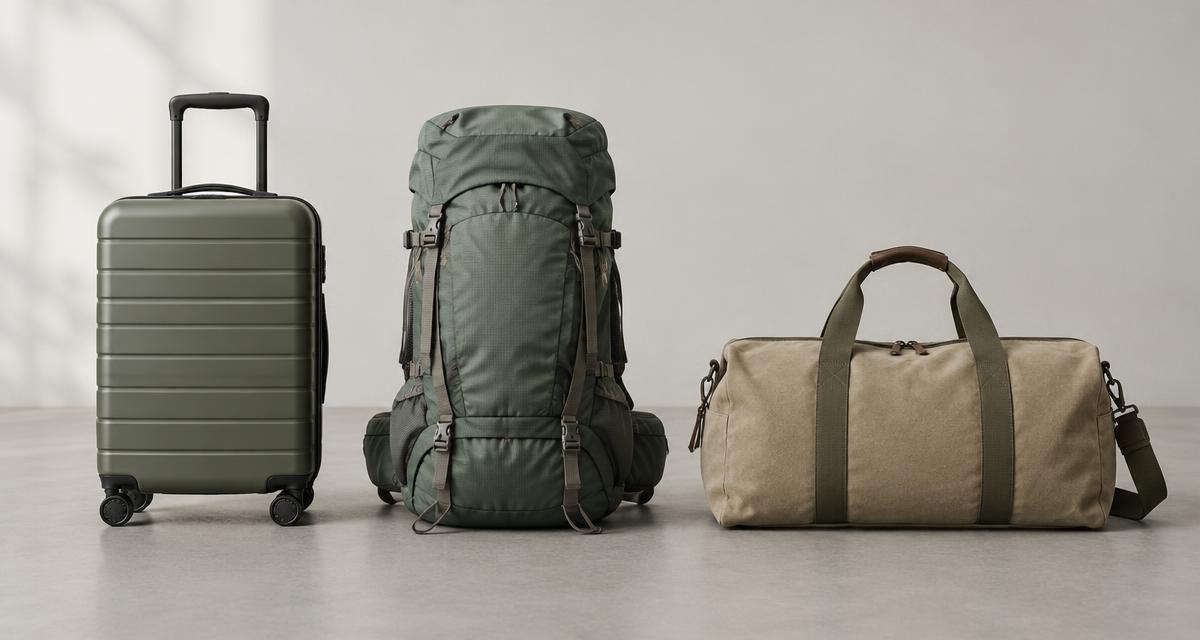
Carry-on suitcase, hiking backpack and canvas duffel bag side by side
Choose your bag around the transfers, surfaces and packing needs of your trip.

4. When a duffel wins

Duffels suit road trips, cabin weekends and equipment-heavy holidays where you carry luggage short distances. Their wide openings make awkward items easier to load, and soft sides can fit around other bags in a car boot. An empty duffel may also take less storage space at home than a rigid suitcase.

The compromise arrives when the walk gets longer. A single shoulder strap puts the load on one side, and an unstructured bag can sag against your leg. Backpack straps help with occasional carries, but basic webbing straps are not equivalent to a fitted backpack harness. Check whether the handles remain comfortable when the bag is full.

For adventure travel, ask the operator about luggage arrangements before choosing a size. Some vehicle transfers prefer soft bags; others have specific limits. Separate muddy footwear and damp clothing rather than trusting a tough outer fabric to protect everything inside.

5. Check airline limits before choosing capacity

“Carry-on” is a description, not a universal airline approval. Cabin dimensions, weight allowances and personal-item rules vary by airline, fare and sometimes aircraft. Check your own airline for every flight, including connecting services, and confirm whether your allowance is included or costs extra.

Measure the packed bag, including wheels, handles and bulging pockets. A litre rating describes capacity, not whether a bag fits a particular sizer. Expansion zips can push a suitcase beyond the allowance, while an overfilled backpack may be too deep even if its advertised dimensions looked suitable.

Weigh everything together, including electronics and the bag itself. A lighter empty bag leaves more room within a weight allowance, but not if you compensate by packing extra clothes. Keep medication, valuables and essential documents accessible in case your main cabin bag has to travel in the hold.

6. Spend money on the features you will notice

Check wheels for smooth movement and excessive wobble, and handles for a secure grip. Ask whether replacement wheels or handles are available. On backpacks, inspect strap stitching and adjustment hardware. On duffels, pay particular attention to where the handles join the body: those points bear repeated lifting.

Run every zip around its corners. It should move without catching or needing you to force the fabric together. Lockable pulls can discourage casual opening, but they do not make a bag theft-proof. Water-resistant fabric is useful for showers; it is not a promise that seams and zips will keep belongings dry in sustained rain.

Compare empty weight, reinforced wear areas and repair options rather than judging quality by a material name alone. Inside, enough organisation is helpful; too many fixed compartments can restrict awkward items. Our guide to travel packing cubes explains how removable organisers can work across different bags.

7. Match the bag to your next real trip

For a weekend city break with a direct hotel transfer, choose a compact suitcase unless stairs dominate the route. For backpacking across several towns, prioritise a comfortable travel backpack and a manageable load. For a driving holiday with outdoor kit, a duffel is often easier to arrange around boots and equipment.

Business travel usually rewards accessible electronics, tidy clothing storage and easy movement through terminals. A suitcase with a small work bag may suit you better than one enormous backpack. Keep documents reachable without opening your main luggage; the travel wallet guide can help you choose a practical setup.

Before removing the tags, pack your normal belongings, weigh the bag and practise lifting and carrying it at home, following the retailer’s return conditions. Then work through your overseas travel checklist. If the bag fits your allowance and feels manageable when full, you have a better reason to keep it than any long list of features.

Check your own trip in 30 seconds

Enter your passport expiry date and destination to see your last safe entry date, visa status, documents checklist and readiness score.

Run the free checker

Keep reading

Do You Need a Passport to Go to the Bahamas?

Whether you need a passport for the Bahamas depends on how you travel, your citizenship and how long you stay. Here is what to carry by air, by sea and by cruise.

Do You Need a Passport to Go to Mexico?

Flying to Mexico, driving across the border, or arriving by ship? The document rules differ. Here is what US, Canadian and other travellers should carry.

Do You Need a Passport to Go on a Cruise?

Closed-loop cruises, one-way sailings and repositioning voyages have different document rules. Here is when a passport is required and when it is only strongly advised.

How to Get a Visa for Europe

Schengen short-stay visas, national long-stay visas and the new ETIAS travel authorisation explained, with the documents, timings and costs to plan for.

Passport Expiring Soon Before a Trip? What to Check First

A practical decision guide for a passport near expiry: check the destination's validity rule, connections, airline requirements and renewal options before you travel.

Travelling Internationally With Children: Document Checklist

What to prepare when a child crosses borders: passports, parental consent, name differences and where to check the rules for your actual itinerary.

Do You Need a Transit Visa for a Connecting Flight?

A connection can come with its own entry rules. Learn how to check airside transfers, self-transfers, baggage collection and transit visa requirements.

How Long Does It Take to Get a Passport? Planning Your Timeline

Passport processing times change through the year. Learn how to build a safe timeline, when to pay for faster service and what to do if your trip is close.

Lost Your Passport Abroad? What to Do, Step by Step

A calm, practical plan for a lost or stolen passport overseas: reporting it, contacting your embassy, emergency travel documents and rebooking your trip home.

Can You Travel With a Damaged Passport?

Water damage, torn pages, a loose cover or a damaged chip can get you refused boarding. Here is how to judge normal wear against damage that needs replacing.

REAL ID vs Passport: What ID Do You Need for US Domestic Flights?

Since REAL ID enforcement began, adults need an accepted ID at US airport security. Learn when a passport works, what counts as REAL ID and what to do without one.

The EU Entry/Exit System (EES) Explained for Travellers

The EES replaces passport stamps with digital records of fingerprints and a facial image at Schengen borders. Here is who it affects and how to prepare.

Travel Insurance Calculator: How Much Travel Insurance Do You Really Need?

A practical way to work out how much medical, cancellation and baggage cover your trip needs, and how to compare quotes fairly using a simple calculator.

JR Pass Calculator: Calculate Whether a Japan Rail Pass Is Worth It

How to add up your Japan train journeys, compare them with the current JR Pass price, and decide whether the pass or single tickets make more sense.

Travel Time Calculator: How to Calculate Your Total Travel Time

Door-to-door travel time is much more than the flight. Here is how to add up every stage of a journey, including time zones, layovers and the airport.

Flight Distance Calculator: Find the Distance Between Any Two Cities

How flight distance is measured, why great-circle routes look curved on maps, and what distance tells you about flight time, fares and points.

Travel Cost Calculator: How Much Will Your Trip Really Cost?

A step-by-step method for estimating the real cost of a trip, including the small, forgotten expenses that blow most travel budgets.

Qantas Points Calculator: How to Calculate the Value of Your Travel Points

How to work out what your Qantas Points are actually worth on a specific redemption, and how to tell a good use of points from a poor one.

Exchange Rate Calculator: Calculate Currency Conversion Before You Travel

How exchange rates, margins and card fees really work, and how to calculate what your money will be worth before you leave home.

Japan Travel Guide: How to Calculate Your Budget, Distance, Time and Transportation Costs

A planning guide for Japan that shows you how to calculate your daily budget, distances between cities, journey times and transport costs.

Travel Insurance: What Does It Cover and How Much Could You Save With the Right Policy?

What travel insurance usually covers, what it often excludes, and how the right policy can protect you from the costs that hurt most when a trip goes wrong.

Best Travel Packing Cubes: 15 Packing Cubes That Make Packing Easier

Compare 15 packing cube options by packing style, suitcase fit and practical trade-offs, with a carry-on packing example and a buying checklist.

Best Travel Wallets: 15 Travel Wallets to Keep Your Essentials Organized

Find a travel wallet that fits your documents and daily routine: 15 options, passport storage tips, security trade-offs and a pre-flight checklist.

Best Places to Travel With Kids: 25 Family-Friendly Destinations

Explore 25 family holiday ideas with age suitability, manageable day plans and honest planning trade-offs, from city breaks to nature trips.

Best Places to Travel Solo: 25 Amazing Destinations for Solo Travelers

Compare 25 solo travel destinations by transport, social opportunities and planning challenges, with a first-trip checklist and practical safety habits.

Travel Itinerary Template: How to Plan the Perfect Trip Step by Step

Copy a practical travel itinerary template and plan your route, transfers, daily priorities, budget and backup options without overfilling every day.

Japan Travel: The Ultimate Japan Travel Guide for First-Time Visitors

Plan your first Japan trip with a realistic Tokyo and Kyoto route, transport choices, accommodation checks, food guidance and practical arrival advice.

Travel Insurance 101: What It Covers and Whether You Really Need It

What a standard travel insurance policy actually pays for, what it usually excludes, who can safely skip it, and how to decide for your specific trip.

Best Travel Insurance in 2026: How to Compare Plans and Avoid Costly Gaps

A step-by-step method for comparing travel insurance plans — limits, excess, exclusions and claim processes — so you can spot costly gaps before you buy.

Post Office Travel Insurance: Is It Worth It, or Should You Buy Elsewhere?

How to judge a familiar high-street insurance brand: who underwrites the policy, what to check in the wording, and when comparison shopping pays off.

Do You Need a Travel Pillow? The Best Neck Pillows for Flights and Road Trips

Whether a neck pillow is worth packing, the main types and who each suits, and how to test one at home before a long flight.

Dyson Travel Hair Dryer Review: Is the Compact Version Worth the Price?

A research-based look at premium compact hair dryers for travel: weight, power, voltage issues, and when a cheap dryer or the hotel dryer is smarter.

Travel Agent vs. Booking Yourself: Which Saves More Money and Stress?

What travel agents actually do today, when they genuinely save you money or hassle, when booking yourself wins, and what to ask before paying a fee.

Costco Travel Review: Are the Vacation Packages Actually a Good Deal?

How warehouse-club vacation packages work, and a step-by-step method to check whether a specific package beats booking the parts separately.

Travel Visa Basics: How to Know If You Need One Before You Book

What a visa is, the main types from visa-free to embassy visas, and a step-by-step way to check any destination's requirement with official sources.

Overseas Travel Checklist: 15 Things to Sort Out Before You Leave

Fifteen practical things to sort before an international trip — documents, money, health, home and tech — each with the why and the how.

This article is general information, not legal or immigration advice. Entry and document rules change often — always confirm with the official government authority for your destination and with your airline or cruise line before you travel. Read our full disclaimer.