Do You Need a Travel Pillow? The Best Neck Pillows for Flights and Road Trips

Updated October 24, 2026 · 8 min read · Checked against official sources · Editorial policy

Memory foam travel neck pillow on an airplane window seat above the clouds

A travel pillow is easy to buy in an airport and surprisingly awkward to carry once you discover it does not suit your neck. Some people find one makes an upright nap possible; others spend the flight pushing it out from behind their head. The difference is usually fit, sleeping position and seat shape, not how impressive the packaging looks.

There is no single best neck pillow for everyone. Before adding another bulky item to your bag, work out what support you actually need. This guide compares the main designs without brand rankings or claims of hands-on product testing.

1. Do you need a travel pillow at all?

Start with a simpler question: will you realistically try to sleep sitting up? On a short daytime flight, you may prefer the space in your bag. If you rarely nap while travelling, a pillow can become luggage you carry out of habit rather than something you use.

It becomes more useful when your head repeatedly drops sideways as you doze, or when you have a long overnight journey in an upright seat. Someone with a lie-flat bed usually needs a different kind of cushioning, not a thick collar around the neck. A supportive adjustable headrest may also be enough.

Think beyond the flight duration, too. Our guide to calculating total travel time helps you see the whole journey. Several short connections can mean hours of carrying a pillow but little uninterrupted time to sleep. Existing neck pain deserves individual medical advice; a travel accessory is not treatment.

2. Memory foam U-shapes: support with a bulk penalty

A memory foam U-shaped pillow is worth considering if you want substantial side support and do not mind carrying something bulky. Foam contours under pressure, while taller sides can reduce how far your head tips. Some designs have a front fastening that helps keep the sides together, although this does not guarantee good chin support.

The common drawback is thickness behind the neck. Against an upright headrest, a chunky rear section may push your head forward rather than let it rest naturally. Look for a flatter back if that happens to you. Tall sides can also crowd a shorter neck, interfere with headphones or feel uncomfortably warm.

Foam varies in firmness, so the material label alone tells you little about fit. Check whether the cover comes off and whether a compression pouch is included. Compression reduces packing size, but it does not make the pillow weightless or eliminate the space it needs.

3. Inflatable, wrap and microbead pillows: the trade-offs

Inflatable pillows suit travellers who value small packed size. You can adjust firmness by releasing air; filling one completely may make it feel hard and bouncy. The compromises are possible leaks, valve placement and a surface that can feel clammy without a fabric cover. Check how easily it inflates and deflates before departure.

Wrap or scarf-style pillows use fabric, sometimes with an internal support, to brace one side of the head or jaw. They can feel less bulky behind the neck than a U-shape. However, they may feel hot or restrictive, and positioning matters. Check whether the support works on either side and whether the fastening is comfortable rather than tight.

Microbead pillows contain small beads that shift as you settle. They are often light and easy to mould around a shoulder, but the filling can move away from the place where you want support. Many are bulky despite their low weight. Inspect seams and check cleaning instructions, especially if the cover cannot be removed.
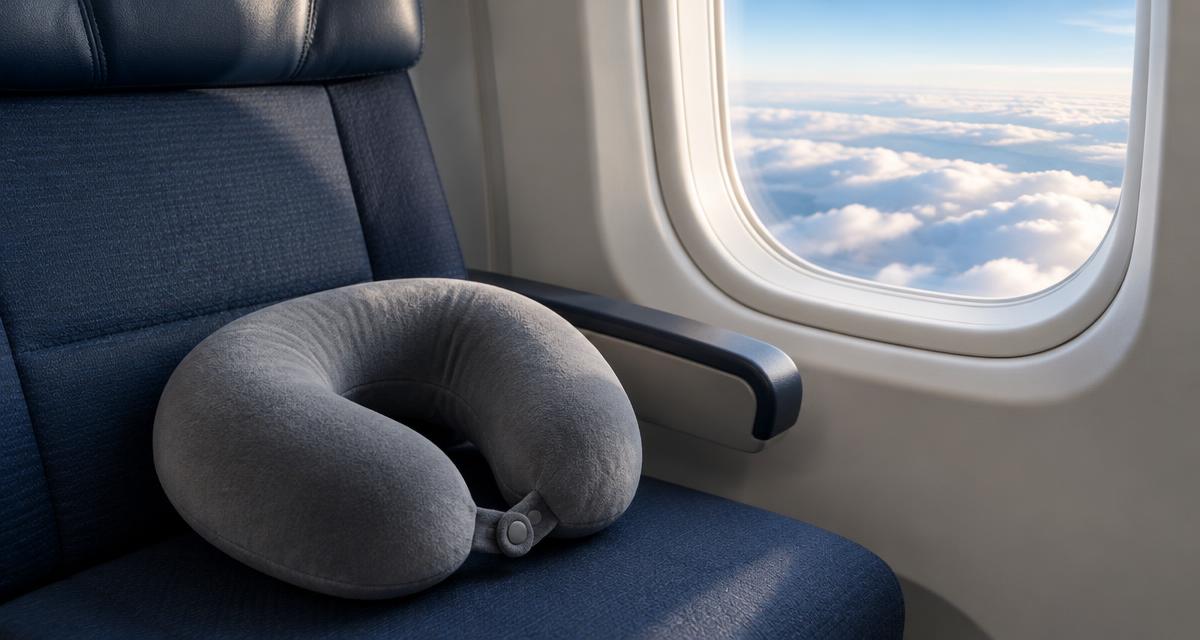
Memory foam travel neck pillow on an airplane window seat above the clouds
Match the pillow’s height and rear thickness to the seat you will actually use.

4. Match the support to the way your head falls

Notice what happens when you relax in a high-backed chair. If your head tips sideways, look for enough side height to meet it without lifting your shoulder. If your chin drops forward, an open U-shape may do very little. A design with front support might help, provided it does not press against your throat or force your jaw upward.

Window leaners may prefer cushioning between the head and the side of the cabin, but do not assume every window seat has a conveniently positioned wall. Keep fabric away from sharp fittings, and avoid wedging yourself into an awkward angle just to make a pillow work.

For centre or aisle seats, self-contained support matters more because there is no wall to lean against. Check compatibility with glasses, earrings and headphones. The useful fit is the one that lets your head stay reasonably neutral, not the one that holds it most firmly.

5. Choose differently for flights and road trips

On an overnight flight, support and heat management may matter more than the smallest packed size. On a multi-stop trip with a small backpack, an inflatable option may be the better compromise. Before choosing, consider where it will live alongside your other belongings; our guide to carry-on suitcases, backpacks and duffels can help you plan that space.

For a road-trip passenger, test the pillow against the actual vehicle headrest while parked. Stay properly seated with the seat belt correctly positioned, and do not use padding that changes belt fit or pushes your head into an uncomfortable position. Avoid excessive reclining to chase a sleeping posture.

Drivers should stop somewhere safe to rest when tired, not use a pillow to keep driving. For children, follow the car-seat manufacturer’s instructions and avoid unapproved accessories that could interfere with the restraint.

6. Give it a proper trial before departure

Try the pillow in a firm, high-backed chair for fifteen or twenty minutes, rather than judging it from a quick squeeze. Wear your usual travel layers and headphones. Let your shoulders relax, then notice whether the pillow supports your head or simply fills the space around your neck.

Turn your head gently in both directions. You should be able to remove the pillow easily, and no fastening should feel constricting. Check for pressure under the jaw, a forward-pushed head or a growing urge to shrug your shoulders. Stop if you experience pain, numbness or tingling.

An at-home trial cannot reproduce aircraft noise or every seat shape, but it can reveal obvious fit problems. Check the return policy before opening packaging, since used bedding or personal accessories may have restrictions. Keep the packaging until you know the pillow is staying.

7. Keep it clean and give it a packing place

A removable, washable cover is a practical advantage when something sits against your face for hours. Follow the care label: washable fabric does not mean the foam core or internal support can go in the machine. Let everything dry completely before packing it away.

Keep the pillow in a clean pouch rather than dangling it against station floors, toilet doors and luggage wheels. If you attach it outside your bag, secure it so it cannot swing into people or catch on fittings. Check your airline’s baggage rules rather than assuming an attached pillow never counts toward your allowance.

The best choice is the smallest, simplest pillow that solves your actual problem. If none feels better than the seat headrest, leave it behind. Travelling comfortably sometimes means packing one useful thing; sometimes it means having one less thing to carry.

Check your own trip in 30 seconds

Enter your passport expiry date and destination to see your last safe entry date, visa status, documents checklist and readiness score.

Run the free checker

Keep reading

Do You Need a Passport to Go to the Bahamas?

Whether you need a passport for the Bahamas depends on how you travel, your citizenship and how long you stay. Here is what to carry by air, by sea and by cruise.

Do You Need a Passport to Go to Mexico?

Flying to Mexico, driving across the border, or arriving by ship? The document rules differ. Here is what US, Canadian and other travellers should carry.

Do You Need a Passport to Go on a Cruise?

Closed-loop cruises, one-way sailings and repositioning voyages have different document rules. Here is when a passport is required and when it is only strongly advised.

How to Get a Visa for Europe

Schengen short-stay visas, national long-stay visas and the new ETIAS travel authorisation explained, with the documents, timings and costs to plan for.

Passport Expiring Soon Before a Trip? What to Check First

A practical decision guide for a passport near expiry: check the destination's validity rule, connections, airline requirements and renewal options before you travel.

Travelling Internationally With Children: Document Checklist

What to prepare when a child crosses borders: passports, parental consent, name differences and where to check the rules for your actual itinerary.

Do You Need a Transit Visa for a Connecting Flight?

A connection can come with its own entry rules. Learn how to check airside transfers, self-transfers, baggage collection and transit visa requirements.

How Long Does It Take to Get a Passport? Planning Your Timeline

Passport processing times change through the year. Learn how to build a safe timeline, when to pay for faster service and what to do if your trip is close.

Lost Your Passport Abroad? What to Do, Step by Step

A calm, practical plan for a lost or stolen passport overseas: reporting it, contacting your embassy, emergency travel documents and rebooking your trip home.

Can You Travel With a Damaged Passport?

Water damage, torn pages, a loose cover or a damaged chip can get you refused boarding. Here is how to judge normal wear against damage that needs replacing.

REAL ID vs Passport: What ID Do You Need for US Domestic Flights?

Since REAL ID enforcement began, adults need an accepted ID at US airport security. Learn when a passport works, what counts as REAL ID and what to do without one.

The EU Entry/Exit System (EES) Explained for Travellers

The EES replaces passport stamps with digital records of fingerprints and a facial image at Schengen borders. Here is who it affects and how to prepare.

Travel Insurance Calculator: How Much Travel Insurance Do You Really Need?

A practical way to work out how much medical, cancellation and baggage cover your trip needs, and how to compare quotes fairly using a simple calculator.

JR Pass Calculator: Calculate Whether a Japan Rail Pass Is Worth It

How to add up your Japan train journeys, compare them with the current JR Pass price, and decide whether the pass or single tickets make more sense.

Travel Time Calculator: How to Calculate Your Total Travel Time

Door-to-door travel time is much more than the flight. Here is how to add up every stage of a journey, including time zones, layovers and the airport.

Flight Distance Calculator: Find the Distance Between Any Two Cities

How flight distance is measured, why great-circle routes look curved on maps, and what distance tells you about flight time, fares and points.

Travel Cost Calculator: How Much Will Your Trip Really Cost?

A step-by-step method for estimating the real cost of a trip, including the small, forgotten expenses that blow most travel budgets.

Qantas Points Calculator: How to Calculate the Value of Your Travel Points

How to work out what your Qantas Points are actually worth on a specific redemption, and how to tell a good use of points from a poor one.

Exchange Rate Calculator: Calculate Currency Conversion Before You Travel

How exchange rates, margins and card fees really work, and how to calculate what your money will be worth before you leave home.

Japan Travel Guide: How to Calculate Your Budget, Distance, Time and Transportation Costs

A planning guide for Japan that shows you how to calculate your daily budget, distances between cities, journey times and transport costs.

Travel Insurance: What Does It Cover and How Much Could You Save With the Right Policy?

What travel insurance usually covers, what it often excludes, and how the right policy can protect you from the costs that hurt most when a trip goes wrong.

Best Travel Packing Cubes: 15 Packing Cubes That Make Packing Easier

Compare 15 packing cube options by packing style, suitcase fit and practical trade-offs, with a carry-on packing example and a buying checklist.

Best Travel Wallets: 15 Travel Wallets to Keep Your Essentials Organized

Find a travel wallet that fits your documents and daily routine: 15 options, passport storage tips, security trade-offs and a pre-flight checklist.

Best Places to Travel With Kids: 25 Family-Friendly Destinations

Explore 25 family holiday ideas with age suitability, manageable day plans and honest planning trade-offs, from city breaks to nature trips.

Best Places to Travel Solo: 25 Amazing Destinations for Solo Travelers

Compare 25 solo travel destinations by transport, social opportunities and planning challenges, with a first-trip checklist and practical safety habits.

Travel Itinerary Template: How to Plan the Perfect Trip Step by Step

Copy a practical travel itinerary template and plan your route, transfers, daily priorities, budget and backup options without overfilling every day.

Japan Travel: The Ultimate Japan Travel Guide for First-Time Visitors

Plan your first Japan trip with a realistic Tokyo and Kyoto route, transport choices, accommodation checks, food guidance and practical arrival advice.

Travel Insurance 101: What It Covers and Whether You Really Need It

What a standard travel insurance policy actually pays for, what it usually excludes, who can safely skip it, and how to decide for your specific trip.

Best Travel Insurance in 2026: How to Compare Plans and Avoid Costly Gaps

A step-by-step method for comparing travel insurance plans — limits, excess, exclusions and claim processes — so you can spot costly gaps before you buy.

Post Office Travel Insurance: Is It Worth It, or Should You Buy Elsewhere?

How to judge a familiar high-street insurance brand: who underwrites the policy, what to check in the wording, and when comparison shopping pays off.

The Best Travel Bags for Every Type of Trip: Carry-On, Backpack, or Duffel?

How to choose between a carry-on suitcase, travel backpack and duffel by trip type, which features actually matter, and how to judge quality before you buy.

Dyson Travel Hair Dryer Review: Is the Compact Version Worth the Price?

A research-based look at premium compact hair dryers for travel: weight, power, voltage issues, and when a cheap dryer or the hotel dryer is smarter.

Travel Agent vs. Booking Yourself: Which Saves More Money and Stress?

What travel agents actually do today, when they genuinely save you money or hassle, when booking yourself wins, and what to ask before paying a fee.

Costco Travel Review: Are the Vacation Packages Actually a Good Deal?

How warehouse-club vacation packages work, and a step-by-step method to check whether a specific package beats booking the parts separately.

Travel Visa Basics: How to Know If You Need One Before You Book

What a visa is, the main types from visa-free to embassy visas, and a step-by-step way to check any destination's requirement with official sources.

Overseas Travel Checklist: 15 Things to Sort Out Before You Leave

Fifteen practical things to sort before an international trip — documents, money, health, home and tech — each with the why and the how.

This article is general information, not legal or immigration advice. Entry and document rules change often — always confirm with the official government authority for your destination and with your airline or cruise line before you travel. Read our full disclaimer.